Why a tankless heater needs flushing
Water heated inside the unit leaves minerals behind. Over time that scale coats the heat exchanger and narrows the waterways, which lowers flow and makes the unit work harder.
Flushing means running a descaling solution, usually white vinegar or a manufacturer-approved product, through the heat exchanger and then rinsing it with clean water. Most makers recommend doing it regularly, and more often where the water is hard.
Why Trussville's water makes this worth doing
Trussville Gas and Water's 2026 report lists total hardness as 205, though the table does not print a unit. The water comes from eight groundwater wells in the Tuscumbia-Fort Payne chert and Bangor limestone aquifers.
Limestone-fed groundwater tends to carry dissolved minerals. If you want a number for your own tap, test it, and ask the utility how to read the report. In the meantime, treat a tankless heater here as a unit that benefits from a regular flush.
Signs your unit needs flushing
Any of these suggests scale buildup.
- Lower hot water flow than before.
- Longer waits before the water turns hot.
- Error codes about flow or temperature.
- Noise from the unit that it did not make when new.
How to flush a tankless water heater
Follow your manufacturer's instructions, which can differ. This is the general pattern.
- Turn off power and gas, then close the cold and hot water isolation valves.
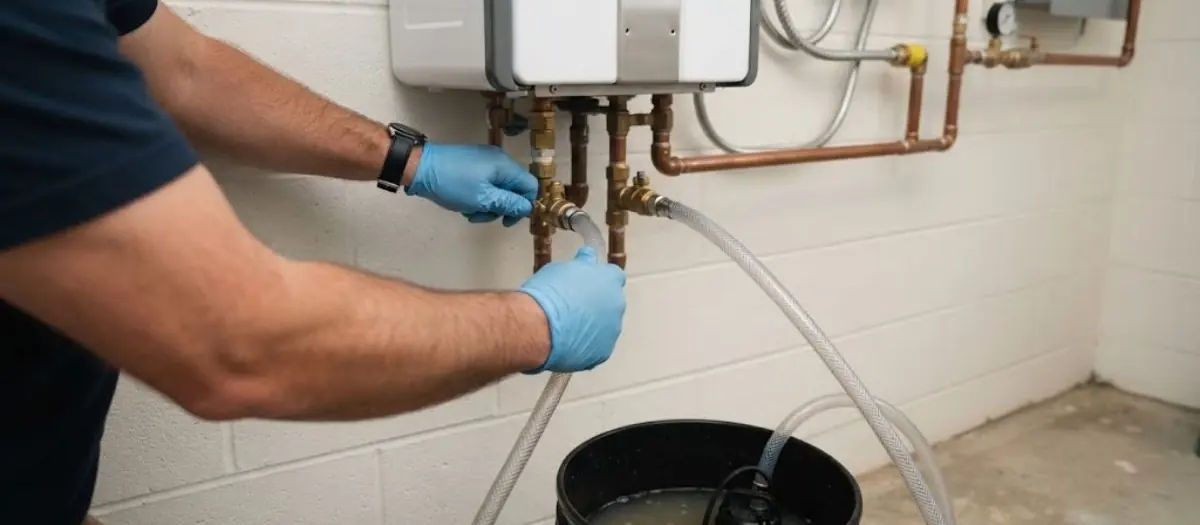
- Connect hoses to the service ports, with one hose running to a bucket and the other to a small pump in a bucket of descaling solution.
- Open the service valves and run the solution through the heat exchanger for the time the manual suggests, often around an hour.
- Rinse with clean water, close the service valves, reopen the isolation valves, clear any air and restore power and gas.
Not comfortable doing it yourself? Call and we will flush your tankless unit.
Call (205) 896-0120What you need
Gather the supplies before you start.
| Item | Why |
|---|---|
| Submersible pump and two hoses | To circulate solution through the unit. |
| Two buckets | One for solution and one for drain water. |
| White vinegar or approved descaler | To dissolve the scale. |
| Isolation valve kit | To make flushing possible, if the unit has none. |
| Gloves and eye protection | For hot water and cleaning solution. |
What if there are no service valves
Some older installations have no isolation valves, which makes flushing hard. A plumber can add a service valve kit to the cold and hot lines, and it is a small job that makes every future flush much easier.
If you are thinking of a new tankless unit, ask that the installer include valves from the start. See tankless water heater for how we approach new installs.
Draining a tank heater is different
A tank heater is drained through a valve at the bottom, usually with a garden hose, and the point is to remove sediment that settles in the tank. A tankless unit has almost no water in it, so flushing is about the heat exchanger, not sediment.
If you have a tank heater and want to flush it, our page on water heater repair covers the signs that it needs attention. Do not use a tank heater's drain procedure on a tankless unit.
How often to flush
Manufacturers commonly suggest about once a year, and sooner in hard water areas. Check your manual, and note the date each time you do it so you can track the interval.
If your unit shows scale after a year, flush more often. If the water in your area gets softer or you add a softener, you can stretch the interval a little.
Safety before you start
Gas and power must be off before any flushing begins, and the water in the unit can be hot. Let the heater cool for a bit if it has just run, and wear gloves and eye protection.
Be sure the hoses are secure at both ends. A hose that slips off an open service valve will spray hot water across the room, so tighten the connections and keep a towel nearby.
Closing up and checking your work
After the rinse, close the service valves and reopen the isolation valves slowly. Open a hot tap in the house so trapped air can escape, and let water run until the flow is steady.
Restore power and gas, run the unit and listen for odd noises. Check each connection for drips over the next day, and note the date so you know when the next flush is due.
When flushing is not enough
A unit with heavy scale may not recover with a standard flush, and a heat exchanger can be damaged beyond cleaning. If flow stays low or the unit shows repeating error codes, a technician should look at it.
Our page on water heater repair describes what we check, and if the unit is old and failing, water heater replacement may be the better path.
Keeping a simple maintenance log
Write down the date of each flush, the solution you used and how the flow felt before and after. A small log tells you how fast scale builds in your house, and it helps a technician if a problem shows up later.
It also helps with warranty claims, since some manufacturers ask for proof of regular maintenance. A note on the wall near the heater, or a phone reminder, is all it takes.
The utility's water treatment and your heater
The utility's 2026 report describes treatment with coagulation, flocculation, chlorination, filtration, fluoridation and pH adjustment for corrosion control. Treatment makes the water safe to drink, and it does not remove hardness.
For questions about the report, call Trussville Gas and Water at 205-655-3211. For questions about your heater, a plumber can read the scale in the heat exchanger and tell you what it means.
Draining a tankless heater questions
The solution usually runs through for around an hour, plus setup and rinsing. Allow a couple of hours the first time.
Many manufacturers approve it, but not all. Check your manual before you use it.
The utility's 2026 report lists total hardness as 205, and the table does not print a unit. Test your own tap to get a figure you can compare.
Yes. We serve Springville, Pinson, Clay and Leeds.
The heat exchanger may be badly scaled or damaged, or the cause may be elsewhere. Call us and we will diagnose it.