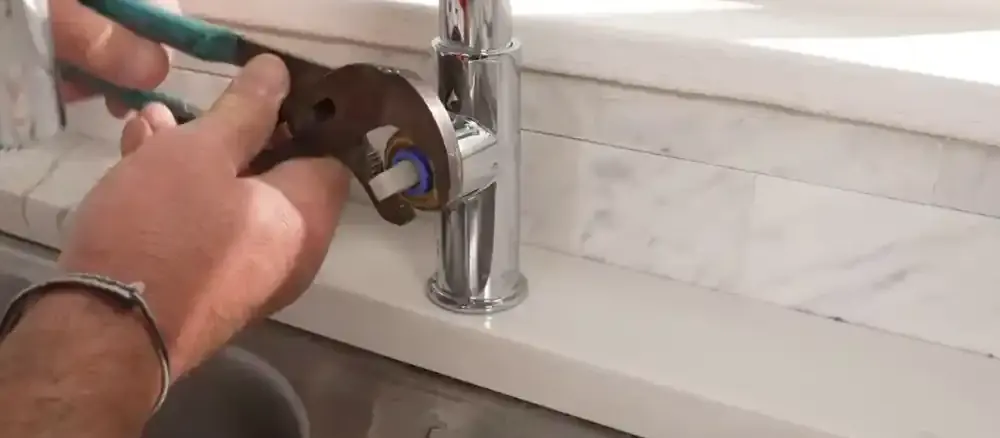
Start by working out what kind of faucet you have
The repair depends on the design. Compression faucets have two handles and rubber washers, cartridge faucets use a plastic or brass insert, ball faucets have a single handle on a rotating ball, and ceramic disc faucets use two polished discs.
Look under the handle for a set screw or a cap, and note the brand name on the body. That information helps you find the right part, and it tells a plumber what to bring to the visit.
Symptoms and likely causes
Most faucet problems have a recognizable pattern.
| Symptom | Likely cause | Usual fix |
|---|---|---|
| Drip from the spout | Worn washer, seat or cartridge | Replace the part. |
| Leak around the handle | Worn O-rings or loose packing nut | Replace the O-rings, tighten the nut. |
| Low or uneven flow | Clogged aerator or valve | Clean or replace the aerator. |
| Hard-to-turn handle | Mineral buildup in the cartridge | Clean or replace the cartridge. |
| Water under the sink | Failed supply line or shutoff valve | Replace the line or valve. |
A basic cartridge or washer repair
This is the general order. Your faucet's manufacturer may differ.
- Close the shutoff valves under the sink, then open the faucet to release pressure.
- Remove the handle by loosening the set screw or cap, then take off the escutcheon and any retaining nut.
- Pull out the cartridge or washer, compare it to the replacement and install the new part with a little plumber's grease on the seals.
- Reassemble, open the shutoffs slowly and check for leaks at the handle and spout.
Faucet still dripping after a repair? Call and we will take a look.
Call (205) 896-0120The aerator is the simplest fix of all
The aerator is the small screen at the tip of the spout. Mineral flakes and debris collect there, and a clogged aerator makes the faucet spray sideways or run weakly.
Unscrew it by hand or with a cloth and pliers, rinse it, soak it in vinegar if there is scale and put it back. It takes a few minutes and often solves a problem people assume is much bigger.
Why hard water wears out faucets
Trussville Gas and Water's 2026 report lists total hardness as 205, and the table does not print a unit. The water comes from eight groundwater wells in limestone and chert aquifers, which is a source that tends to carry dissolved minerals.
Minerals form scale on cartridges, seals and aerators. That is one reason faucets can wear faster than their rated life. If you want a number for your own tap, have it tested, and ask the utility how to read the report.
When to repair and when to replace the faucet
A repair makes sense when the body is sound and the finish is good. A replacement makes sense when the finish has failed, parts are hard to find or the faucet has needed a repair every year.
Replacing is also a chance to upgrade, for example to a pull-down kitchen model. Our page on faucet repair explains how we decide, and plumbing installation covers new fixtures.
Shutoff valves and supply lines
The small valves under the sink let you stop the water to one faucet. If they are corroded, stuck or missing, a simple repair becomes a whole-house shutoff, and that is the moment many people call a plumber.
Braided supply lines last a long time but can fail at the connection. If yours are old, stained or bulging, replace them when you do other work under the sink.
What to do if the leak is under the sink
Close the shutoff valves, dry the cabinet and look for the source. A drip from the faucet base, a wet supply line connection and a leak from the drain trap can all look similar.
Wipe each part dry, put a dry paper towel beneath it and check again after a few minutes. The towel shows which connection is actually wet, and that guides the fix.
Pull-out sprayers and kitchen hoses
Kitchen faucets with pull-out or pull-down spouts have a flexible hose under the sink that wears with use. A cracked hose or a loose quick-connect fitting causes leaks that look like a faucet problem.
Look for dampness along the hose and at the connection under the sink. Most hoses are replaceable, and a new one is far cheaper than a new faucet.
Outdoor spigots in cold weather
A hose left on a spigot in freezing weather can trap water in the faucet and the pipe behind it. When that water freezes, the pipe can split inside the wall, and the leak only shows once it thaws.
Disconnect hoses before a freeze, and use an insulated cover if the spigot is not frost-proof. If the spigot drips inside the wall after winter, shut the interior valve and call.
A short toolkit for faucet repair
An adjustable wrench, a screwdriver set, hex keys, plumber's grease, a flashlight and a small bowl for screws cover most jobs. Take a photo at each step so you remember how the parts go back.
Bring the old cartridge or washer to the store to match it, since sizes vary by brand and year. If the faucet is more than fifteen years old, parts may be hard to find, and replacement can be the simpler path.
Your faucet and the water that feeds it
For questions about water quality and hardness, Trussville Gas and Water can be reached at 205-655-3211. Its 2026 report describes treatment steps and lists measured values.
For a faucet that is leaking inside the wall, a quick check is a damp cabinet back or a musty smell. In that case, leak detection finds the source with less damage than opening the wall.
Flow standards behind your faucet
According to the EPA's WaterSense program, a labeled bathroom faucet is limited to 1.5 gallons per minute, and the aerator sets that flow. A clogged aerator is the usual reason a faucet stream changes.
Plumbing codes such as the IPC and UPC also call for a shutoff valve at each fixture, which is why adding one is a worthwhile upgrade.
Faucet repair questions
Yes. A steady drip wastes water and adds to your bill, and the repair is usually small. Waiting can also damage the faucet seat, which makes the fix larger.
A cartridge, washer or aerator swap is a reasonable job for many homeowners. A leaking supply line, a corroded valve or a hidden wall leak is better left to a plumber.
It can. Mineral scale wears seals and clogs aerators. Trussville Gas and Water's 2026 report lists hardness as 205 without a printed unit, so cleaning the aerator once or twice a year is a good habit.
Yes. We serve Pinson, Springville, Clay and Leeds.
Close the shutoff valves and call the 24/7 line. If the valves will not close, shut the main water valve for the house.