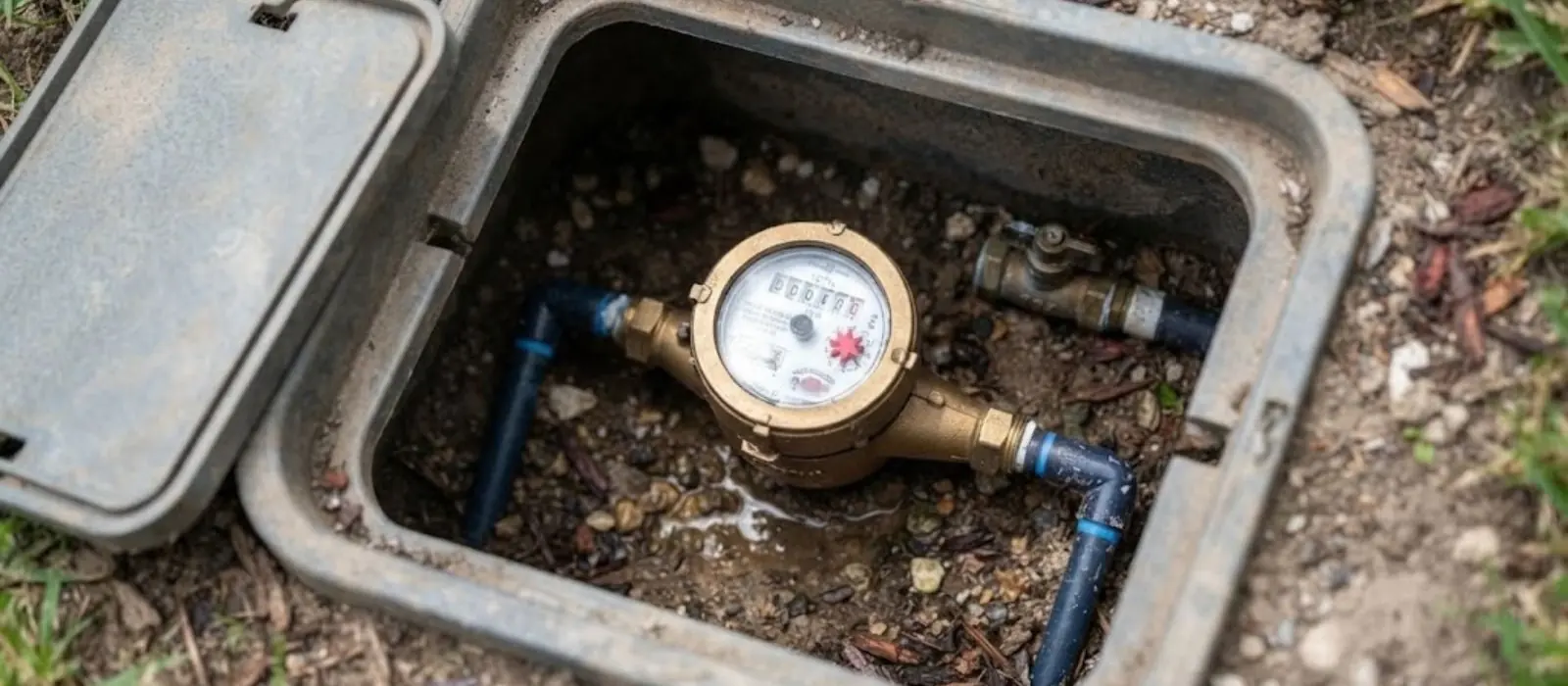
Start with the meter
Turn off every faucet and appliance that uses water, including the ice maker and the irrigation system. Then look at your water meter, where a small dial or triangle spins when any water flows.
If the indicator moves with everything off, water is escaping on your side of the meter. Note the reading, wait fifteen minutes without using water and look again. A change confirms a leak, and it can be as small as a toilet flapper.
A simple leak hunt in order
Work through these checks before you call anyone.
- Run the meter test with every tap and appliance off.
- Check each toilet with a few drops of food coloring in the tank. If color reaches the bowl without flushing, that toilet leaks.
- Look under every sink, behind the washer and around the water heater for drips or damp spots.
- Check outdoor spigots, hose connections and the irrigation system for wet ground and constant flow.
Where leaks hide and how they show
Different locations have different clues.
| Location | Clues | What to try |
|---|---|---|
| Toilet | Hissing, running or color in the bowl | Replace the flapper or fill valve. |
| Under sinks | Damp cabinet, musty smell | Tighten or replace the supply line. |
| Water heater | Wet floor, rust at the base | See water heater repair. |
| Yard | Soggy ground, low pressure | Check for a service line leak. |
| Inside walls or slab | Stains, warm floor, high bill | Call for detection equipment. |
Meter still moving with every tap off? Call and we will find the leak.
Call (205) 896-0120Read your bill like a detective
Compare your recent bills with the same months last year. A jump with no change in household habits is a clue, and so is a steady rise month over month.
Note your usual usage in gallons or cubic feet. A leak shows up as a baseline that never drops, even when you were away. If your bill asks you to compare with an average, remember that your own history is the better benchmark.
Why finding the leak early matters
Water that escapes inside a wall or under a floor feeds mold and damages drywall, framing and flooring long before it is visible. A small leak that runs for months can cost more in damage than in the water you pay for.
Catching it early keeps the repair small. A quick meter test costs nothing, and it is worth repeating after any plumbing work or a sudden change in your bill.
When a leak calls for equipment
If the meter confirms a leak and the simple checks find nothing, the leak is hidden. A plumber can use acoustic listening gear, thermal imaging and pressure tests to narrow the search to a small area.
Our page on leak detection explains the tools, and if the leak turns out to be between the meter and the house, water service line repair is the next read.
What to do once you find it
Close the shutoff valve to the leaking fixture, or the main valve if you cannot isolate it. Dry the area, photograph the damage and keep any wet materials until your insurer says otherwise.
Then arrange the repair. A fixture leak is a quick fix, and a leak behind a wall or in a pipe needs a plumber who can open only the necessary area.
Irrigation systems, pools and outdoor taps
An irrigation system can leak from a broken head, a cracked valve or a buried line, and the water often disappears into the lawn without a puddle. A pool with an auto-fill valve can also mask a leak by topping itself up.
Shut off the irrigation controller and the pool fill when you run the meter test. If the meter stops, the leak is in that system, and a sprinkler or pool specialist can take it from there.
Appliances that leak quietly
A dishwasher, washing machine, ice maker line or water softener can drip for weeks behind a cabinet or a wall. Braided washer hoses wear out, and a loose ice maker line can run unseen behind the refrigerator.
Pull the appliance out and look at the floor and hoses at least once a year. Replace old rubber hoses with braided stainless ones, and close the washer valves when you go away for a long trip.
Freeze damage and sudden leaks
A pipe that split in a cold snap may not leak until it thaws, and then it can pour water into a wall. Check exposed pipes after a hard freeze, and listen for water running when nothing should be on.
If you find a burst pipe, close the main valve and call. Our burst pipe repair page explains what to do next and how repairs work.
Leak sensors and shutoff devices
Small battery-powered leak sensors sit near the water heater, under sinks and by the washer, and they sound an alarm when they get wet. Some systems add an automatic shutoff valve on the main line.
These do not find a hidden leak, but they warn you early and limit damage. They cost little compared with a flooded floor, and a plumber can install a shutoff valve at the same visit as other work.
Ask the utility about meters and bills
Trussville Gas and Water, at 205-655-3211, handles questions about meters and billing. If you suspect the meter itself is wrong, the utility can test it.
The utility's 2026 water quality report also covers treatment and measured values for the system. It does not describe your own pipes, so a hidden leak inside your property is yours to find, and a plumber can help.
Where the leak numbers come from
According to the EPA's WaterSense program, the average household's leaks can waste nearly 10,000 gallons of water a year, and the EPA suggests checking your meter with all water off.
That is the same test we describe above, and it costs nothing to run.
Household leak detection questions
It varies, but a steady drip adds up to many gallons a day over time. A running toilet can waste far more than a faucet drip.
Usually yes, with the next billing cycle. Compare the new bill with your older baseline to confirm.
Yes. The meter marks the boundary, and a leak before it is the utility's concern. Call 205-655-3211 if the leak is clearly at the meter or in the street.
Yes. We serve Clay, Pinson, Leeds and Springville.
If water is actively spraying or pooling, yes. For a slow leak, you can leave it on until a plumber arrives, though closing the main stops the loss.