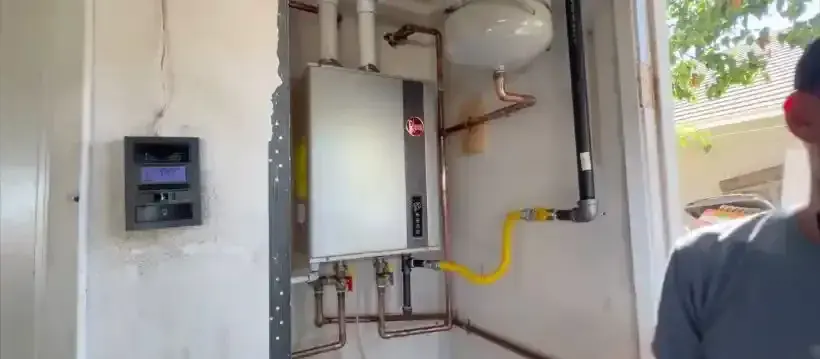
What makes a gas tankless install different
A gas tankless heater fires a large burner for as long as hot water runs. That means more gas than a typical tank needs at any one moment, a vent suited to its exhaust and a place for condensation to drain if the unit is a condensing model.
These requirements are where most of the cost and complexity come from. Before you choose a unit, plan to have the gas line, vent route and wall location checked. Our page on tankless water heaters explains the options in more detail.
What the install needs
Check each item before you buy.
| Item | Why it matters | Common issue |
|---|---|---|
| Gas line size | The unit draws a lot of gas at once | An older line may be too small. |
| Vent type and route | Exhaust must go outside safely | Long runs or tight spaces add cost. |
| Water connections | Isolation valves allow flushing | Old fittings may need replacing. |
| Condensate drain | Condensing models make acidic water | Needs a nearby drain or neutralizer. |
| Electrical outlet | Needs power for the fan and controls | Outlet may need adding. |
A typical install, step by step
Plans vary by house, and the manufacturer's instructions control.
- Confirm the gas line capacity, vent route and wall space, and choose a unit sized to your hot water demand.
- Shut off gas and water, drain and remove the old tank, then mount the new unit on the wall.
- Run gas, water, vent and condensate lines, adding isolation valves for future flushing.
- Test for gas leaks, check combustion and flow, and set the temperature and controls.
Considering a gas tankless unit? Call and we will check your gas line and vent route first.
Call (205) 896-0120Wait time, recirculation and the cold water sandwich
A tankless heater does not remove the wait for hot water to travel through your pipes. A long pipe run from the heater to a distant bathroom still means a delay while cold water clears the line.
A recirculation pump or a small point-of-use unit can shorten it. Some users also notice a brief burst of cold in the middle of a shower when flow drops and restarts. Ask your plumber about these trade-offs before you buy, since a good design avoids most of them.
What changes the price of the project
The unit itself is only part of the bill. The gas line upgrade, venting, wall location, electrical outlet and condensate drain can each add cost, and older homes tend to need more of them.
A written scope that lists each item makes quotes easy to compare. Ask whether the old tank's removal, any permit and the isolation valves for flushing are included, since those are often left off a low quote.
Sizing the unit to your household
Tankless units are rated by how many gallons per minute they can heat to a set temperature rise. A household that runs two showers and a dishwasher at the same time needs more capacity than one person living alone.
Incoming water temperature matters too. Colder water needs more heating, which lowers the flow a given unit can deliver. A plumber can estimate the right size from your fixtures and your habits.
Gas supply in Trussville
Trussville Gas and Water supplies natural gas in its service area, so ask the utility whether gas is available at your address and what the meter can handle. A larger heater sometimes needs a larger meter or a bigger pipe from the meter to the house.
Gas work should be done by a qualified plumber or gas fitter. The Alabama Plumbers and Gas Fitters Examining Board has a licensee search for consumers, and the City of Trussville's building department at 205-655-5483 can tell you about permits.
Hard water and long-term upkeep
The utility's 2026 water quality report lists total hardness as 205, and the table does not print a unit. The water comes from eight wells in limestone and chert aquifers, a kind of source that can leave scale on a heat exchanger.
Plan for periodic flushing with descaling solution, and have isolation valves installed so it is easy. Our page on water heater installation covers the tank alternative if you want to compare.
Venting choices in an existing house
Condensing tankless units cool their exhaust enough to use plastic vent pipe, often PVC or CPVC, which is easier to route through a wall. Non-condensing units run hotter and need stainless steel vent material, which is more rigid and costs more.
Your existing chimney or flue is rarely a good fit for a tankless unit. Plan the vent route early, since where it exits the house can decide where the heater can go.
Permits, inspection and warranties
Gas work and venting changes usually call for a permit and an inspection. The building department at 205-655-5483 can tell you what Trussville requires for your address.
Keep the paperwork. A manufacturer's warranty may depend on correct installation and on maintenance such as flushing, and your records are the proof.
Questions to ask before you sign
Ask which unit the quote is for, what gas line size it assumes and how the vent will run. Ask whether the price includes a permit, the removal of the old tank and the isolation valves for flushing.
Ask what the warranty covers and what maintenance it requires. A clear, written answer on each point makes it easier to compare quotes on the same terms.
Older homes and the gas line
Houses from the 1980s growth around I-59 and I-459 and earlier Chalkville Road neighborhoods may have gas piping sized for a tank heater and a furnace. Adding a tankless unit can push that line close to its limit.
A quick gas load calculation tells you whether the line is enough. If not, the fix may be a larger pipe, and that decision is better made before the unit is ordered.
Codes and instructions that apply
A gas tankless install follows the manufacturer's instructions and the National Fuel Gas Code, NFPA 54, for gas piping and venting. Plumbing codes such as the IPC and UPC cover the water connections.
Ask whether your jurisdiction requires a permit, and keep the inspection record with your warranty paperwork.
Gas tankless install questions
A straightforward swap can take most of a day. A new vent, larger gas line or relocated unit takes longer.
Sometimes, but tankless units often need different vent material. Check the manufacturer's requirements and local code.
Most need electricity for the fan and controls, so they stop when power is out. A small backup power option may help if that matters to you.
Yes. We serve Leeds, Springville, Clay and Pinson as well as Trussville.
It depends on your gas line, space and hot water use. We look at those details before recommending one.