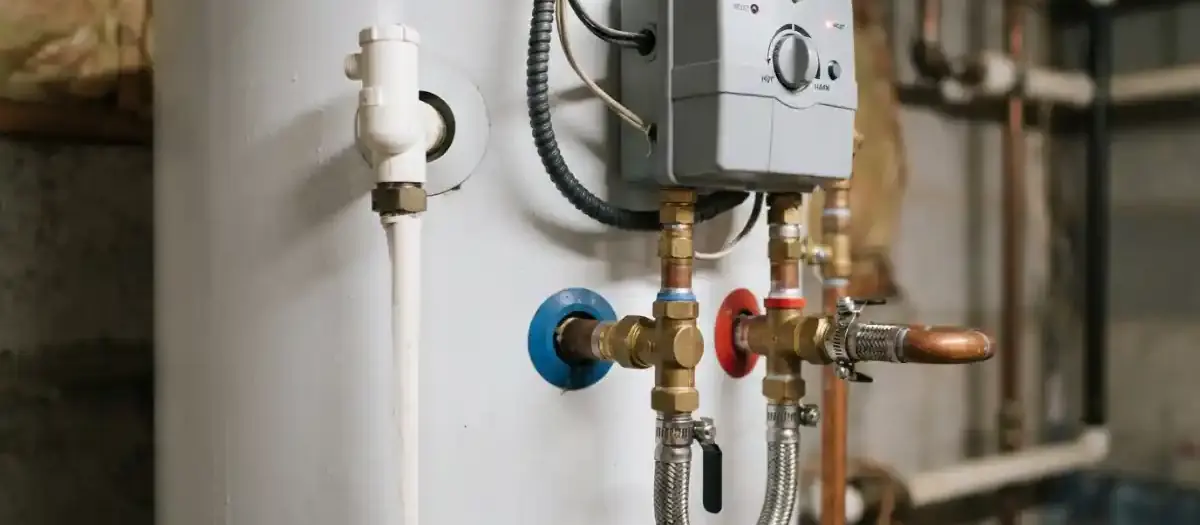
What the pressure valve does and why it matters
A water heater's temperature and pressure relief valve, usually called the T&P valve, opens when pressure or temperature in the tank gets too high. It is the last line of defense if the thermostat fails, and a tank without a working one can become dangerous.
Most residential T&P valves are rated to open at 150 psi or 210 degrees Fahrenheit. A discharge pipe runs from the valve down toward the floor so any release goes somewhere safe. That pipe should never be capped or plugged.
Signs the valve needs attention
These symptoms mean the valve, or the pressure behind it, deserves a look.
- Water dripping from the valve or the discharge pipe.
- Corrosion or mineral crust around the valve opening.
- A valve that never moves when you lift the test lever.
- Water hammer or hissing after hot water use.
A leaking valve is not always a bad valve
A dripping T&P valve can mean the valve is worn, but it can also mean pressure in the system is too high. Thermal expansion pushes pressure up each time the water heats, and in a closed system with no place for that expansion to go, the valve opens a little to relieve it.
If you replace the valve and the new one drips too, pressure is the real problem. An expansion tank or a pressure-reducing valve on the incoming line is often the fix. Ask the utility about incoming pressure at 205-655-3211 and have your plumber measure it with a gauge.
How a valve replacement goes
This is the general order, and the details depend on your tank. Follow the manufacturer's instructions and local code.
- Turn off the gas or the electric breaker to the heater and close the cold water inlet.
- Relieve pressure by opening a hot tap nearby, then lower the tank level enough to work above the valve.
- Unscrew the old valve and the discharge pipe, then thread in a new valve rated for the tank and apply thread sealant.
- Reattach the discharge pipe, refill the tank, open the hot tap until air clears and check for leaks.
Thermal expansion and expansion tanks
Water expands when it heats. In a house where a check valve or pressure regulator keeps water from pushing back into the street main, that extra volume has nowhere to go, and pressure in the heater and pipes climbs.
An expansion tank is a small tank with an air cushion that absorbs the extra volume. It sits on the cold water line near the heater. If your valve drips after every heating cycle, an expansion tank is the first thing to ask about, and it must be set to match your incoming pressure.
What to do while a valve is discharging
If the valve is running steadily or steaming, turn off the gas control knob or the electric breaker to the heater, then close the cold water inlet. Keep people away from the discharge pipe, because the water can scald.
Do not touch the valve with bare hands. Once the heater cools and the valve quiets, call a plumber. A valve that discharges heavily may mean the thermostat has failed and the tank is overheating.
Valve dripping or crusted over? Call and we will check the valve and system pressure.
Call (205) 896-0120Repair or replace the whole heater
A valve is a small part, but what it tells you can matter more than the part itself.
| What you find | Likely cause | Next step |
|---|---|---|
| New valve, no drip after | Worn old valve | Done, test yearly. |
| New valve still drips | High system pressure | Add an expansion tank or regulator. |
| Heavy corrosion on the tank | Tank near end of life | Read water heater replacement. |
| Valve opens with hot water | Thermostat or temperature problem | See water heater repair. |
Choosing a replacement valve
A replacement T&P valve has to match the tank's rating and the length of the probe that reaches into the tank. The label near the valve shows the pressure rating, and the heater's manual lists the right type.
A valve with the wrong rating can fail to protect the tank. If you are unsure, bring the old valve or a photo of the tank label to a supply house, or let your plumber source the right part.
How to test your valve safely
Many manufacturers suggest lifting the test lever briefly once a year, with a bucket under the discharge pipe. Water should flow and then stop when you release the lever. If it keeps running or does not flow at all, the valve is worn.
Be careful, because the water that comes out is very hot. Keep children and pets away, and do not stand in front of the pipe. If you are unsure, ask your plumber to test it during another visit.
Why you should not cap or plug the valve
Some homeowners tired of a dripping valve cap it or plug the discharge pipe. That removes the safety feature and can create a real hazard. A dripping valve is a symptom, and the right response is to find the cause.
If you have been told that a valve is fine to plug, get a second opinion. A working relief valve is a basic requirement for a water heater, and the discharge pipe has to stay open.
Ask the utility about your incoming pressure
Trussville Gas and Water, at 205-655-3211, can tell you about typical pressure in your area. Pressure at your house also depends on elevation and on any regulator on your line.
A plumber with a simple gauge can read your actual pressure at an outdoor spigot, and that number tells you whether an expansion tank or regulator makes sense.
The codes behind the relief valve
Plumbing codes such as the IPC and UPC require a temperature and pressure relief valve on a storage water heater, with a discharge pipe that carries any release to a safe place.
The valve's rating is printed on it and on the tank label, and a replacement must match the tank's rating.
Pressure valve questions
It is a safety issue. A slow drip should be addressed soon, and a valve that is spraying, steaming or running steadily needs a call right away. Shut off the heater's power or gas and the cold supply while you wait.
There is no fixed schedule, though many plumbers replace a valve that has been in place a long time or shows corrosion. A valve that fails a test should be replaced.
Yes. Trussville Gas and Water's 2026 report lists total hardness as 205, though the table does not print a unit. Mineral scale can build around a valve and keep it from seating or moving.
Yes. We serve Leeds, Springville, Clay and Pinson.
It is a manageable repair for some homeowners, but the heater is under pressure and the water is very hot. If you are unsure, hire a plumber.