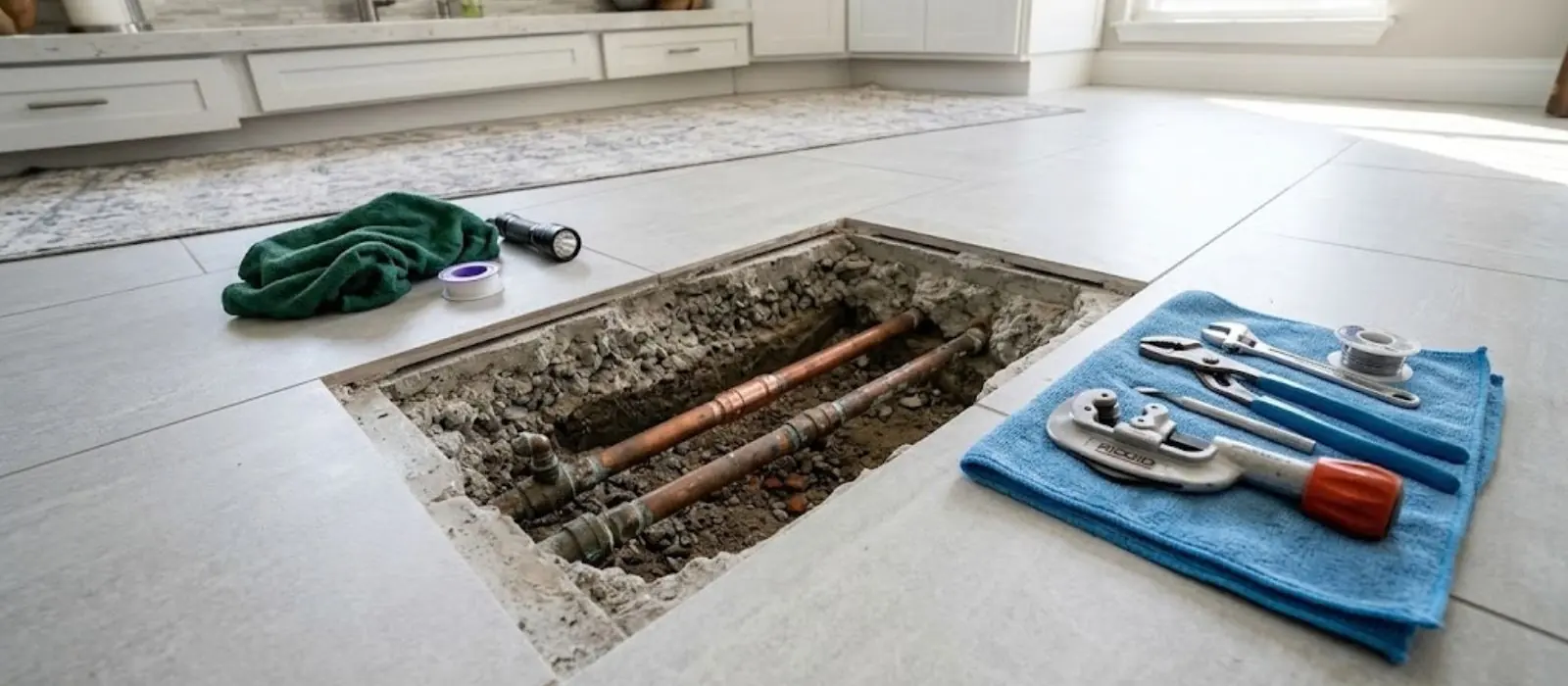
The short answer on slab leak repair cost
Published national guides put slab leak repair at roughly $630 to $4,400 or more, with an average near $2,300, according to This Old House's cost guide updated in April 2026. Those are national figures, not Trussville quotes, and they cover repair only.
Finding the leak is a separate step. The same guide lists slab leak detection at about $150 to $600. Anyone who quotes you a flat number without seeing the house is guessing, so treat a phone price as a starting point and ask for the scope in writing.
Three ways to fix a slab leak, and when each fits
The method decides most of the cost, which is why two homes with the same leak can get very different bills.
| Method | What it involves | Relative cost | Best fit |
|---|---|---|---|
| Spot repair | Cut the slab over the leak, fix the pipe, patch the concrete | Moderate | One clear leak in an otherwise sound line. |
| Reroute | Abandon the leaking line and run new pipe through walls or the attic | Moderate to higher | Leak is hard to reach or the old line is failing. |
| Repipe | Replace the whole supply system | Higher | Repeat leaks or old pipe throughout, see repiping. |
What moves the price up or down
Every house is different, but these five details explain most of the spread between quotes.
Where the leak is
A leak under a bare garage floor is cheaper to reach than one under tile, a kitchen island or a bathtub.
Floor finish
Tile, hardwood and carpet all need to be removed and put back, and matching old tile can be hard.
Pipe material
Copper, PEX and older galvanized lines each repair differently.
How many leaks
A single failure is a spot repair. Several along one line usually point to a reroute.
Timing
Night and weekend calls are quoted as emergency work.
Why detection comes before any digging
Concrete hides the pipe, so the leak is rarely where the wet spot is. Water follows the easiest path under the slab, and a damp patch in one room can come from a pipe several feet away.
Acoustic listening gear, thermal imaging and pressure tests narrow the search to a small area before anyone cuts. Our page on slab leak repair explains each method, and leak detection covers the tools. Paying for detection first almost always costs less than opening the wrong spot.
What a typical slab leak bill is made of
A slab leak invoice usually has four parts: finding the leak, getting to it, fixing the pipe and putting the floor back. Detection is the smallest piece, the plumbing repair is the middle, and restoration of tile, wood or carpet can be the part that surprises people.
Ask who handles each piece. Many plumbers repair the pipe and patch the concrete, then leave finish flooring to a flooring contractor, so budget separately for it. If the quote lumps everything together, ask for a line-by-line breakdown.
Why cheaper is not always cheaper
A very low quote may skip detection, patch only the concrete or leave an aging line in place. If the pipe is corroded in several places, a spot repair can be followed by a second leak a few feet away.
Ask the plumber to look at the pipe's condition when it is exposed and to tell you honestly whether the rest of the line looks sound. That conversation is worth more than a small difference in price.
Warm spot on the floor or a bill that jumped? Call the 24/7 line and ask about detection first.
Call (205) 896-0120How to avoid paying for the same dig twice
A few habits keep a repair from turning into a second one.
- Confirm the leak is under the slab. A meter test with every tap closed tells you whether water is moving.
- Ask the plumber to locate the leak with equipment before quoting the repair.
- Get the method, the patch and the floor restoration described in writing, including who does the flooring.
- Ask whether the old line is likely to fail again, because rerouting can cost less than repairing the same pipe twice.
Insurance and slab leaks
Policies differ, and many treat the repair of the pipe itself as maintenance while covering sudden water damage that follows. Some policies cover the cost of getting to the pipe, often called tear-out, and some do not.
Call your agent before work starts, take photos of any damage and keep every invoice. If a leak has run for months, an insurer may treat it differently from a sudden burst, so ask about the wording on long-term leaks.
Signs your leak may be under the slab
Warm spots on the floor point to a hot water line, and the sound of running water with every tap off suggests a pressurized leak. Damp carpet at a wall base, cracked or lifting tile, a musty smell and a steady rise in the water bill are other common signs.
None of these proves a slab leak on its own. A leaking toilet, an irrigation line or a failing water heater can look the same. That is why we start with a meter test and move to equipment only when the simple causes are ruled out.
What to do if you suspect a slab leak
Acting early limits the damage while you work out the cause.
- Close the main water valve at the house and check the meter again.
- Move rugs and valuables off wet or warm floor areas.
- Photograph the damage and note when you first saw it.
- Call a plumber before you cut or pull up any flooring.
Call 811 before any digging outside
If the repair involves digging in the yard, such as a rerouted service line, call 811 first. The national call-before-you-dig number gets buried utility lines marked, and it applies to any trench or hole.
For permit questions on larger plumbing work, the City of Trussville's Department of Building Safety and Inspections is at 205-655-5483. Ask the office whether your job needs a permit before it starts.
Where these cost figures come from
According to This Old House's cost guide, updated April 2026, slab leak repair averages about $2,300 nationally and detection runs $150 to $600. These are national averages and not quotes.
Local prices depend on access, floor finish and the method, so treat them as context and get a written scope for your own house.
Slab leak cost questions
Yes. Our line is open 24/7, and we book the earliest visit we can. Water running under a slab should be shut off at the main until a plumber arrives.
No, a slab leak needs a concrete slab. Check whether your home sits on a slab, a crawl space or a basement. Crawl space and basement homes can still have hidden leaks, but they are usually easier to reach.
It can be, but it can also be a running toilet or a yard leak. Test the meter first, then read about water service line repair if the leak is between the meter and the house.
A spot repair is often finished in a day or two, plus curing and floor work. A reroute or repipe takes longer.
Yes. We serve Clay, Pinson, Leeds and Springville.